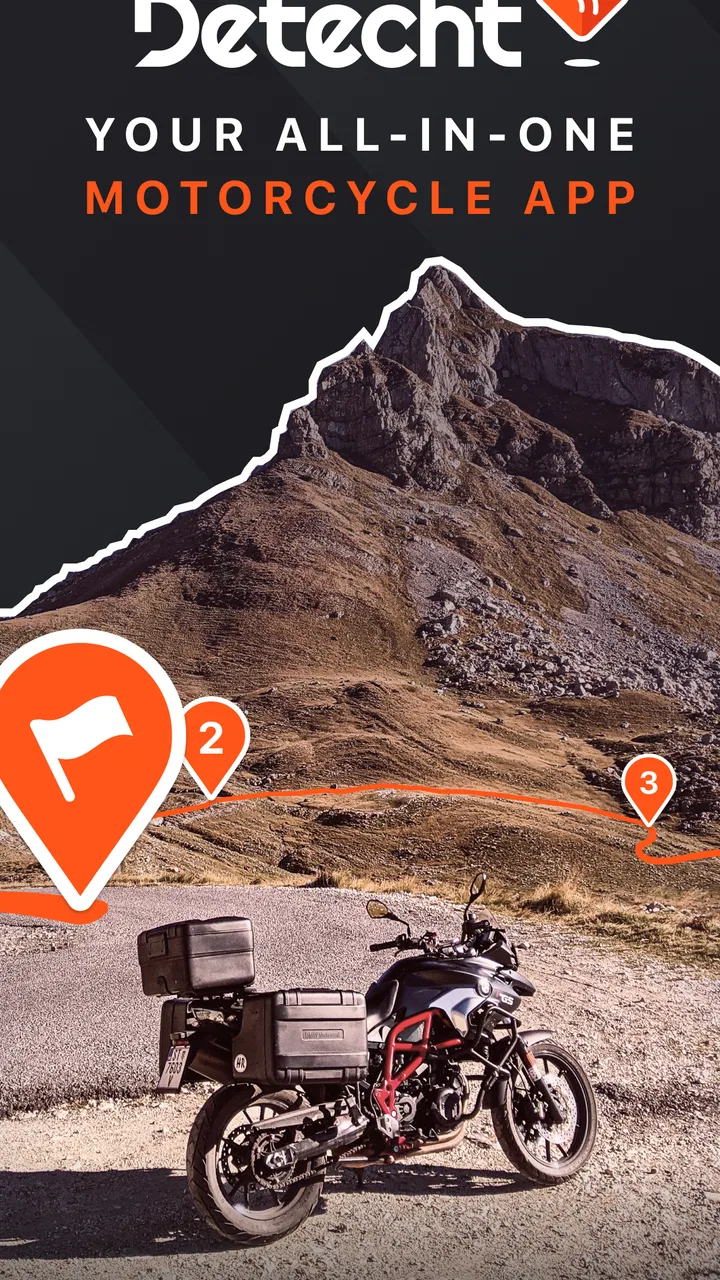
Detecht - Motorcycle App & GPS
- 4.1
- Rating
- 500.00K
- Installs
- Free
- Price

 Analysis by App-foxy
I came away from Detecht with a fairly clear impression: it is most useful when a motorcycle ride is part of the plan, not merely a trip from one address to another. Developed by Detecht Technologies AB, this free Maps & Navigation app is built around motorcycle GPS use, route planning, ride tracking, and crash detection. That focus gives it a different feel from a general navigation app, although it also means it is not automatically the best tool for every journey.
After using it as a rider would, I see its main value in helping turn an ordinary route into a more deliberate ride. The important distinction is that the app is not only concerned with getting me to a destination. It is aimed at the route between the starting point and the finish, which matters when the road itself is the reason for going out. It has passed half a million installs and holds an average rating of 3.8 from roughly three thousand ratings, so it has a meaningful user base without being as universally established as the biggest navigation names.
What makes the motorcycle focus useful
Most familiar navigation apps treat a motorcycle much like a car. They are excellent at finding a fast route, avoiding traffic, and guiding me through unfamiliar streets, but they rarely help me think about the character of the ride. Detecht approaches the problem from the other direction. Its purpose is to help riders plan, navigate, and keep a record of a journey, with crash detection included as part of the safety-oriented design.
You May Also Like

 Blood Strike: 2.5 Anniversary
Blood Strike’s Loadouts Turn Every Drop Into a Tactical Gamble
A close look at Blood Strike’s custom loadouts: how fast access to signature weapons reshapes its battle royale rhythm, rewards preparation, and narrows the gap between fights.

 Pandora - Music & Podcasts
Pandora’s Music Is Easy to Start, but Harder to Recover
Pandora’s strength is its low-effort path from a seed to a station. Its weak spot is how much confidence it asks you to place in connection, setup, and quiet recovery.

 8 Ball Pool
 Is Built on Rivalries, Rematches, and Routine
A close look at the rivalries, rematches, shared routines, and unanswered safety questions that turn a quick pool match into a persistent mobile community.

 Samsung Music
’s Quiet Strength Is Playing What You Already Own
Its reach comes less from spectacle than from dependable access to a personal library. That simplicity is both the app’s strongest retention engine and its ceiling.

 AccuWeather: Weather Radar
AccuWeather Review: A Quick, Clear Forecast for Everyday Decisions
For everyday plans, the best forecast is the one you can understand quickly. AccuWeather makes rain timing, radar, and local conditions easy to act on, with a few trade-offs.

 Hill Climb Racing
Why Hill Climb Racing Still Turns Crashes Into One More Run
A tiny car, a bumpy hill and one more upgrade: Hill Climb Racing keeps resurfacing because its simple chaos makes every near-miss feel personal.
More From Our News Desk



That difference becomes noticeable before I even start moving. For a quick commute, a conventional map may be simpler. For a weekend ride, however, I want to consider more than arrival time. I may prefer a route that feels more enjoyable, gives me a reason to stop, or makes the trip itself worthwhile. A motorcycle-specific tool is better suited to that mindset because it treats route choice as part of the experience rather than as a calculation I should finish as quickly as possible.
One practical workflow I found valuable is separating planning from navigation. I can think about the ride while stationary, adjust the route before putting on gloves, and then use the guidance only after the important decisions are made. That reduces the temptation to make route changes while moving. It also makes the app more useful for group rides: one person can prepare a route in advance, while the others can concentrate on riding instead of stopping repeatedly to compare map options.
The tracking side adds another layer. A ride is not just a line that disappears once I reach the destination. Keeping a record can help me remember which roads I enjoyed, identify sections worth repeating, and compare an exploratory ride with a familiar one. I would not treat the recorded route as a substitute for careful observation, but it is a convenient way to build a personal history of where I have been.
Planning a ride instead of merely finding a destination
The strongest use case is a free afternoon when I want to ride but have no fixed destination. With a standard map, I would normally choose a place first and accept whatever route appears. With this app, the planning process feels more compatible with deciding what kind of ride I want. I can begin with a broad idea, shape the journey, and treat the destination as the final part of the plan rather than the only objective.
That is especially helpful for riders who are still learning their local area. Instead of repeatedly taking the same direct road, I can use a planned route to explore unfamiliar surroundings with more structure. I still need to judge road conditions, weather, traffic, and my own ability, but the app gives the ride a framework. It is a small change in workflow that makes a navigation app feel more like a riding companion.
There is also a useful trade-off here. A route that is enjoyable on a motorcycle may be slower or less convenient than the route a general-purpose app would choose. Detecht makes sense when I value the journey itself. If I am late for work, carrying something fragile, or simply trying to minimize travel time, the usual car-oriented navigation option may be the more sensible choice.
Crash detection and the limits of digital safety
Crash detection is an important part of the app’s identity, but I would treat it as a backup rather than a safety guarantee. Any phone-based detection system can only be one layer in a broader safety routine. A rider still needs proper protective equipment, sensible speed, awareness of changing conditions, and a plan for areas with weak connectivity or limited access to help.
The feature is most reassuring when I think of it as an additional chance to get attention after a serious incident, not as permission to ride more aggressively. That distinction matters. A phone can be damaged, displaced, out of power, or unable to interpret an unusual event perfectly. I would test the relevant settings before relying on them, make sure the phone is mounted and charged appropriately, and avoid assuming that the feature removes the need to tell someone where I am going.
This is also where expectations should remain realistic. Riders often want technology to cover the entire emergency process, but the app’s role is narrower: it contributes crash detection to a motorcycle navigation experience. It does not replace preparation. Used with that understanding, the feature adds meaningful peace of mind. Used as the main reason to take risks, it becomes a false comfort.
How the app feels during an everyday ride
Consider a realistic Saturday scenario. I decide to ride to a café in a neighboring town, but I do not want the most direct road there. Before leaving, I plan a route that makes the trip part of the day, check the overall shape of the journey, and start tracking once I am ready. During the ride, navigation gives me a reference point without changing the purpose of the outing. At the café, I can stop the ride rather than leaving the app running while I am inside.
On the return trip, the recorded route becomes more than a technical log. It reminds me which sections were pleasant and which were tiring or less interesting. If I plan another ride later, I can use that experience to avoid repeating the weaker parts. This is one of the app’s less obvious strengths: its value grows when I use it as a planning journal, not just as a voice or map prompt.
For a daily commute, the benefits are more modest. Tracking may still be useful, and motorcycle-oriented routing can be preferable in some situations, but I would not open a specialized ride-planning app for every short trip unless I genuinely wanted that extra context. The more routine the journey, the more likely a simpler navigation tool will feel faster and less demanding.
Where the experience falls short
The motorcycle focus is also the app’s main limitation. It asks me to think more deliberately about routes, which is helpful for leisure riding but can feel like unnecessary friction when I only need a quick, dependable trip. A general navigation app usually has a more familiar interface for addresses, businesses, traffic, and last-minute changes. Detecht’s appeal depends on whether I want motorcycle-specific planning badly enough to accept a more specialized workflow.
I also would not assume that every planned route will match my personal definition of a good road. A route can look attractive on a map and still be unsuitable because of weather, road surface, visibility, construction, local restrictions, or riding confidence. The app can help me organize a journey, but it cannot know exactly how I will feel on a particular stretch of road. I still need to review the route with common sense and remain willing to abandon it.
Another point of friction is that tracking and navigation encourage longer phone use, which makes the mounting and charging setup important. I would not want to begin a long ride with a nearly empty battery or a phone positioned where it distracts me. This is not a flaw unique to Detecht, but it affects the real experience more than the feature list suggests. A well-planned ride can be undermined by poor device placement, glare, vibration, or the need to interact with the screen at the wrong moment.
The app is free to install, while in-app purchases range from about eight dollars to roughly eighty dollars per item. That pricing structure means I would try the core experience carefully before paying for anything. The right question is not whether extra functions sound attractive, but whether I will plan and record enough rides to justify them. Someone who rides occasionally may be perfectly satisfied with a basic setup, while a frequent touring rider may find paid capabilities more worthwhile.
Its current version is 3.25.7, and it supports devices running Android 8.0 or later. That makes it accessible to many existing Android phones, but anyone using an older handset should check compatibility before building a trip around it. The app is rated for Everyone, which fits its general-purpose presentation, although the riding decisions themselves still require adult judgment and responsibility.
Who will get the most from it
I would recommend Detecht first to riders who enjoy planning the route as much as reaching the destination. It suits weekend explorers, touring riders, and people who want a record of their motorcycle trips. It is also a good match for someone who has outgrown using a car-focused map for recreational rides and wants a tool that recognizes the difference between transportation and riding for pleasure.
It can be useful for a small group as well, especially when one rider takes responsibility for preparing the route. The key is to agree on the plan before departure rather than trying to coordinate through phone screens on the road. A shared route is only helpful if everyone understands the expected stops, pace, and fallback options.
I would be more cautious about recommending it to a rider who wants the simplest possible navigation experience. If the main needs are finding a business, avoiding current traffic, or receiving rapid directions during an unplanned detour, a mainstream map app may be more convenient. I would also suggest skipping it if the safety features are the only attraction. Crash detection is a useful supplement, but it should never be the foundation of a riding safety plan.
Questions worth answering before installing
Is it suitable for beginners? Yes, provided it is used as a planning aid rather than as a replacement for route judgment. A newer rider can benefit from preparing a journey in advance, but should choose roads that match their experience instead of following an interesting-looking route blindly. The app cannot decide whether a particular road is comfortable for a person who is still building confidence.
Can it replace a normal navigation app? In some rides, yes, but I would not replace every map tool with it. Detecht is stronger when the ride is the objective and route planning matters. A general app remains preferable for quick errands, business searches, traffic-heavy commuting, and spontaneous address-based navigation.
Does tracking have a practical purpose? It does if I review the records afterward. Tracking can help me remember a route, identify sections I want to revisit, and understand how I actually spend a riding day. If I never look back at previous rides, the feature becomes little more than background activity and may not justify the extra battery and attention it requires.
Should I pay for in-app purchases immediately? I would not. I would first use the free version during the kinds of rides I normally take, then decide whether the additional functions solve a real problem. The purchase range is broad enough that the decision deserves some thought rather than an impulse tap.
Is crash detection enough to make a ride safe? No. It is a useful additional safeguard, but I would still tell someone my plans on longer rides, carry what I need for changing conditions, keep the phone charged, and ride within my limits. The feature improves the safety net; it does not remove the need for one.
My final assessment
Detecht works best when I use it with a clear purpose: plan a motorcycle ride, navigate it without losing sight of the journey, and keep a record that can inform the next outing. Its strongest qualities come from that focused identity. It does not try to be every kind of map, and that specialization is exactly why it can feel more relevant than a standard navigation app on a recreational ride.
At the same time, I would not call it a universal replacement. The planning emphasis, phone dependence, paid extras, and need for personal route judgment all matter. Riders who want instant directions for ordinary travel may find a conventional option easier. Riders who want to explore, organize, and remember their journeys are the people most likely to appreciate what Detecht is doing.
My recommendation is therefore specific: try it if your motorcycle is a reason to go out, not just a way to get somewhere. Start with a modest ride, prepare the route while stationary, test the tracking and safety settings responsibly, and judge the app by whether it improves the way you ride. For that audience, it offers a thoughtful motorcycle-centered alternative with real practical value, as long as its safety features are treated as support rather than certainty.
FAQs for Detecht - Motorcycle App & GPS
01What features does Detecht - Motorcycle App & GPS offer?
Detecht provides a comprehensive suite of features for motorcycle enthusiasts, including trip planning, GPS navigation, ride tracking, and safety alerts. It also offers community features for sharing rides and connecting with fellow bikers. The app is designed to enhance riding experiences while ensuring safety on the road.
02Is Detecht compatible with both Android and iOS devices?
Yes, Detecht - Motorcycle App & GPS is available for both Android and iOS platforms. Users can download it from the Google Play Store for Android devices or the Apple App Store for iOS devices, ensuring a wide range of compatibility with most smartphones.
03Does Detecht require an internet connection to function?
While Detecht offers offline capabilities, such as pre-downloaded maps for navigation, many features like real-time traffic updates and community interactions require an internet connection. Users can enjoy basic functionalities offline, but a connection will enhance the app's full potential.
04Are there any in-app purchases or subscriptions within Detecht?
Detecht offers a free version with essential features, but there are in-app purchases and subscription options for advanced functionalities. These may include enhanced navigation tools, premium safety alerts, and ad-free usage, providing users with customizable experiences based on their needs.
05How does Detecht enhance motorcycle safety?
Detecht is designed with safety in mind, offering features like automatic crash detection and emergency contacts. The app provides real-time weather updates and route conditions to help riders plan safer journeys. This focus on safety makes it a valuable tool for both novice and experienced riders.
Pros
- User-friendly interface and navigation.
- Real-time route tracking for safety.
- Customizable ride statistics display.
- Offline maps available for remote areas.
- Accident detection feature enhances safety.
Cons
- Some features require in-app purchases.
- Battery consumption can be high.
- Limited compatibility with older devices.
- Occasional GPS signal loss in dense areas.
- User data collection may concern privacy.

Detecht - Motorcycle App & GPS
Gallery